Case Study
FlowForge
A workflow automation product concept for designing repeatable processes, triggers, handoffs, approvals, and execution paths.
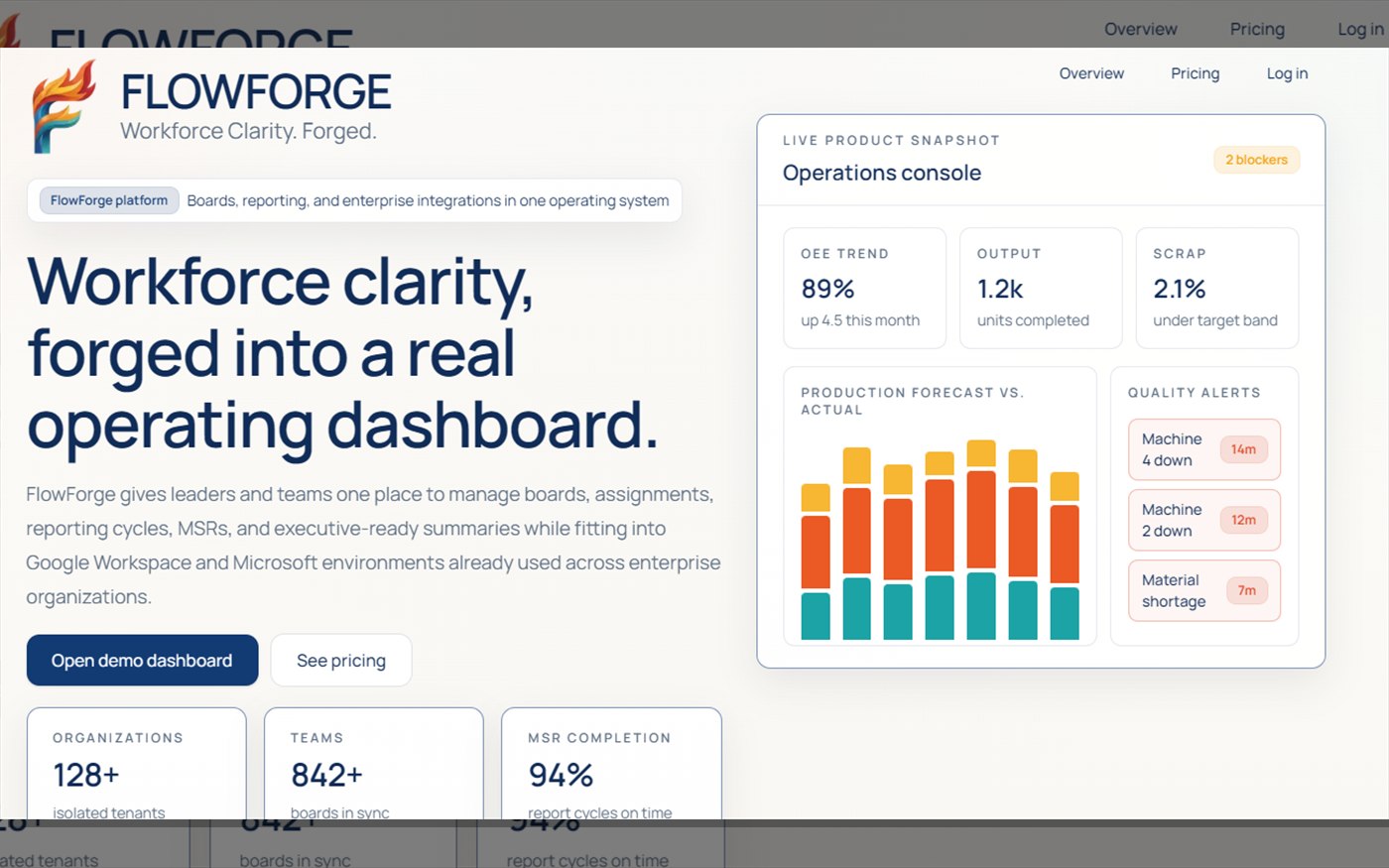
- •Clarified how repeatable business processes can be modeled as reusable workflows.
- •Created a direction for connecting triggers, handoffs, approvals, and execution status.
- •Positioned automation as a visual operating layer instead of a hidden technical setup.
- •Established a product foundation for teams that need process clarity before deeper automation.
Problem
Many businesses want automation, but their processes are not clearly mapped. The work often lives in someone's head, in scattered SOPs, or across disconnected tools. FlowForge addresses that gap by making process design visible and reusable.
Approach
The approach was to design around workflow clarity first. Before a process can be automated, a team needs to see the steps, triggers, handoffs, approvals, and edge cases. FlowForge frames automation as an operational design surface.
Build
The product concept includes workflow maps, reusable process templates, trigger definitions, approval points, handoff logic, and execution visibility. The goal is to let teams build operational flow without needing to start from low-level automation rules.
Results
FlowForge creates a clearer bridge between process documentation and automation. It gives teams a way to design the work, understand the flow, and prepare repeatable systems for execution.
Start a discovery assessment and we’ll map the public experience, business console, workflows, integrations, and first useful release.
Start Assessment →Business framing
Problem
The business needed more than a marketing website. The platform had to support customer activity, content, operational visibility, and ongoing management.
Solution
CEL3 shaped the public experience and supporting platform architecture so the client could manage the business with fewer disconnected tools.
Business Impact
The result is a centralized system that gives the client more control over daily operations and creates a stronger foundation for future workflow and AI features.